Macro Desk Note · August 6, 2026
WARSH vs. WALL STREET
THE NFP SHOWDOWN
A Fed chair many investors expected would lean more dovish, a market that refuses to fall — and Round Three that lands in less than 24 hours.
Sherif Saad · Regime Intelligence · Not financial advice
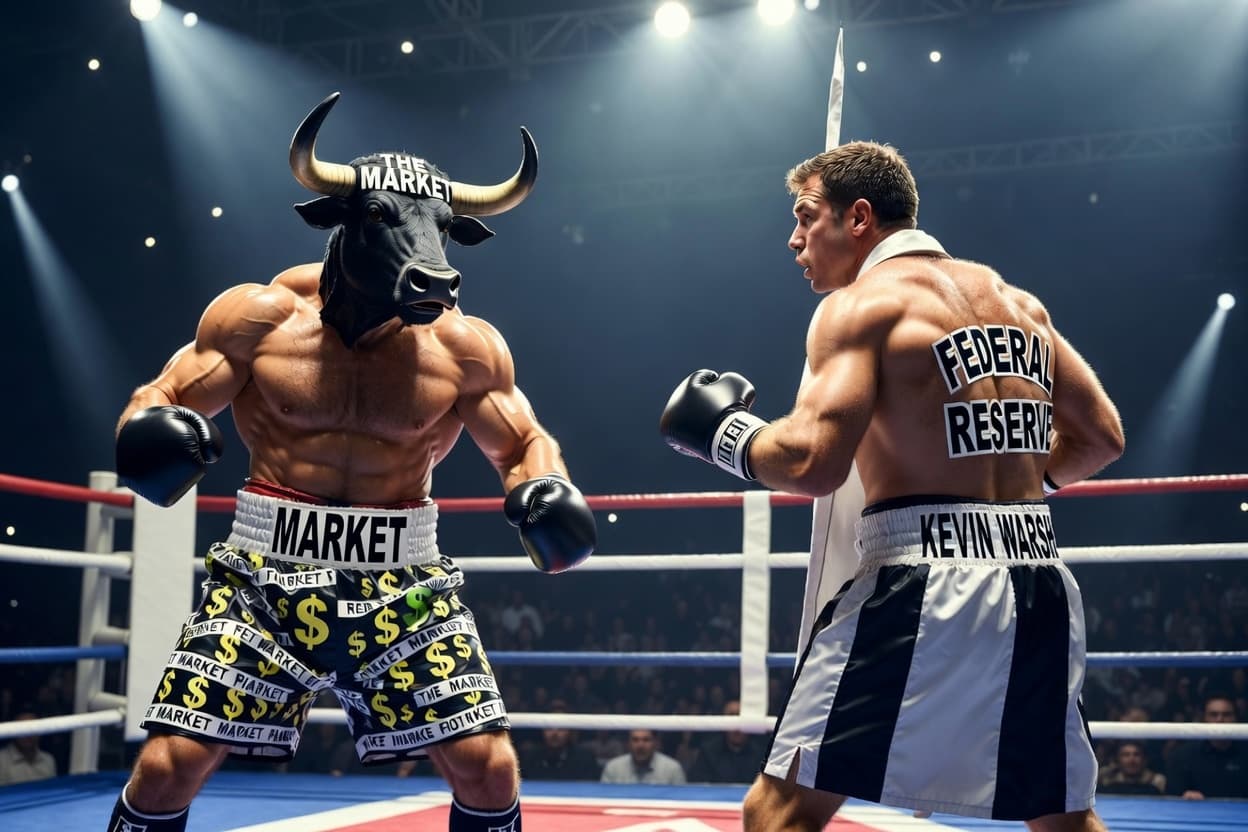
Round One — toe to toe, June 17, 2026
THE FIGHT
Part I — When the market stopped listening to the tone.
When Kevin Warsh was sworn in on May 22, 2026, the market thought it knew exactly what it was getting. This was the man who had repeatedly criticized the Fed's policy stance and was widely viewed by markets as more dovish than his predecessor — Trump's pick, walking in with what many interpreted as a dovish mandate. Many investors initially viewed his appointment as likely to result in a more accommodative Fed before the first bell had even rung.
Round One told a different story.
Round One — The First Bell (June 17)
Warsh's debut meeting produced a unanimous vote to hold rates at 3.50%–3.75% — but buried inside the Summary of Economic Projections was the more consequential signal: the committee's own dot plot was split 9-9 between “hold or cut” and “hike,” with the median dot pointing toward a hike before year-end. For a chair the market had priced as soft, that was already a jab few expected. He also stripped the post-meeting statement down from 300+ words to 130, and made clear forward guidance was gone — from here on, the Fed would talk through the data, not through Warsh.
The market took the jab. It didn't fall.
DXY · Regime Intelligence engine (Asset Sheet cards)
DXY · US Dollar Index (composite)
$99.9802 ▲ +0.29380 (+0.3%)
Snapshot · Aug 6, 2026 · 18:42 ET
Same five-state regime labels and Market Structure reads as the RI Asset Sheet — pulled from the live engine at snapshot time.
Regime — all timeframes
Market structure
Round Two — The Body Shot (July 29)
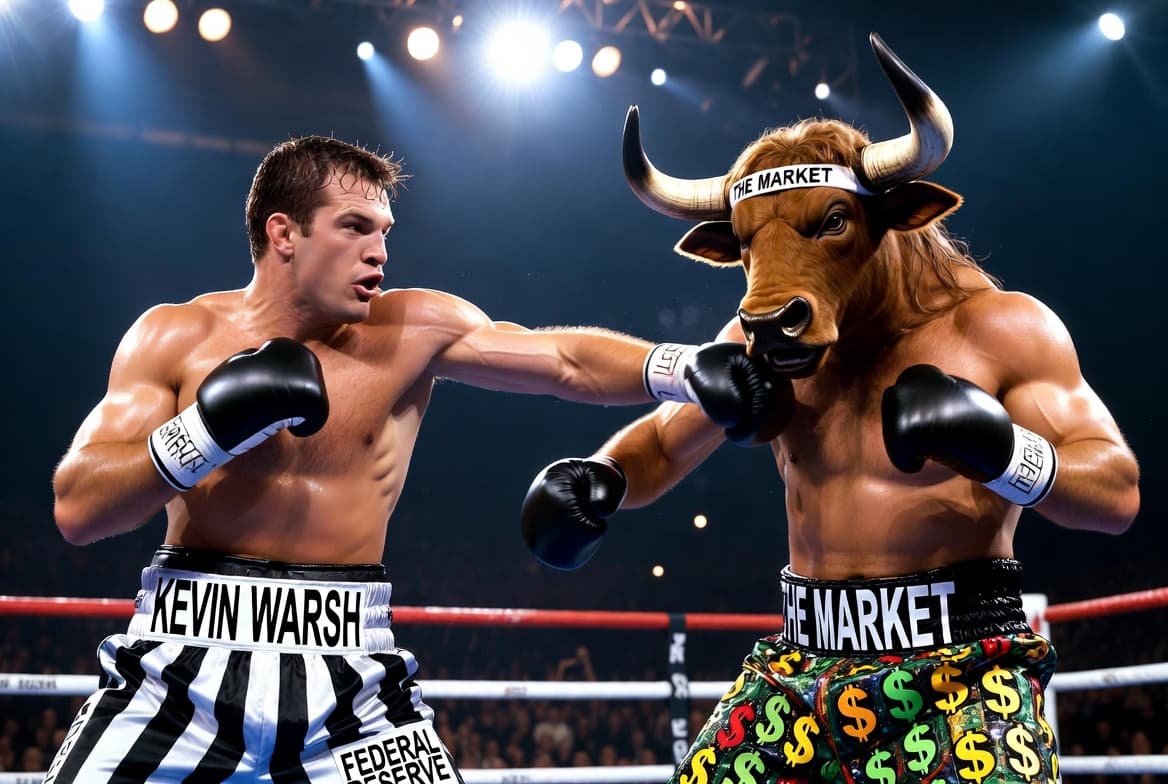
Round Two — the warning, July 29, 2026
If June was a jab, July was a body shot. The FOMC held rates again, but this time the vote itself fractured: 9–3, with three regional presidents dissenting in favor of an immediate hike — the most contested vote of Warsh's short tenure. His press conference doubled down: no soft inflation target, no implicit tolerance band, “the beginning of the story, not the end.” Markets initially sold off hard into the close.
And then, days later, the S&P 500 made a new all-time high anyway.
This is the moment that should give every market participant pause. It's when I started to feel like the market is being genuinely stubborn with the Fed — taking real punches and refusing to go down. September hike odds spiked as high as 82% on the oil-driven inflation scare; by this week they'd been cut nearly in half, back down into the high-50s to low-60s, with a smaller ~10% probability still priced for a larger 50bp move. Multiple punches, and the market just… stood there. Absorbing it. Rocky IV, Balboa against Drago — except nobody's sure yet whether this is grit or denial.
“Has the past really passed?”
In his July 29 opening remarks, Warsh posed this as the first of four questions the Committee wrestled with — whether five-plus years of above-target inflation have left lasting scarring in expectations and pricing behavior that outlives the shocks that caused them. It's a hysteresis argument, not just a data question: a single cool print doesn't prove the past is behind us, so the burden of proof sits with the data, not with the Fed's restrictive stance. It's also the intellectual bridge to the 9–3 split — the three dissenters simply weren't convinced the past had passed at all.
The question that matters
Has the market genuinely stopped caring about the rate path — or is it in a denial phase, still convinced cuts are coming no matter what the Fed says out loud? Because if it's the second one, the reckoning — when it comes — won't be gentle.
Round Three — Tomorrow, 8:30am ET
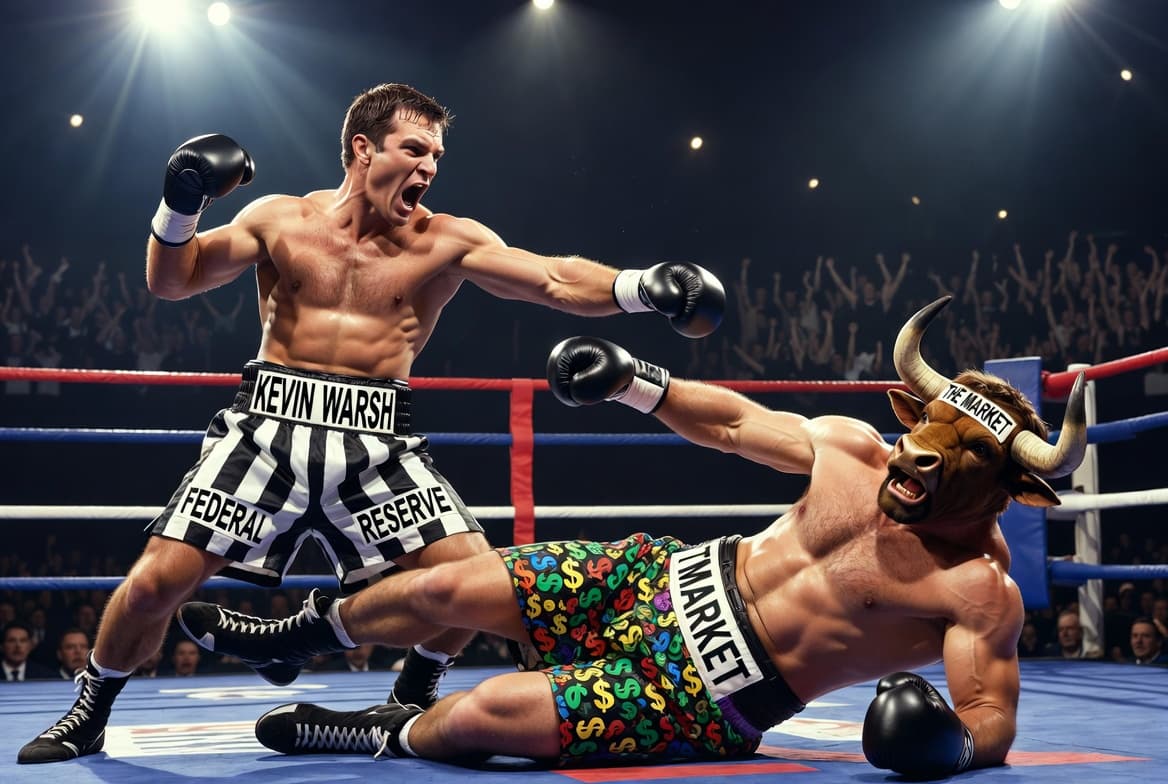
Round Three — the hit, which might land tomorrow
Tomorrow's July jobs report is shaping up as another good-news-is-bad-news, bad-news-is-good-news trade. Consensus sits around 80K, though a handful of institutions are calling for something closer to 120–125K. What makes this print genuinely two-sided: this week's ADP print came in well below consensus at just +44K — and historically, a soft ADP has often preceded an NFP that surprises to the upside, not the downside. Nobody walks into this one with a clean read.
- A miss likely sends the S&P testing fresh highs — soft labor data reads as cooling, which pressures the Fed away from a hike and possibly softens Warsh's tone toward the market's favorite phrase: “wait and see.”
- A beat reopens the case the hawks have been making since July 29 — and could be the punch that finally buckles the market's knees, right as September hike odds were just starting to come back down.
Either way, this is the round where we find out whether Round Two's resilience was real conditioning — or just a bull that hasn't felt the follow-through yet.
Round Four — Still Unwritten
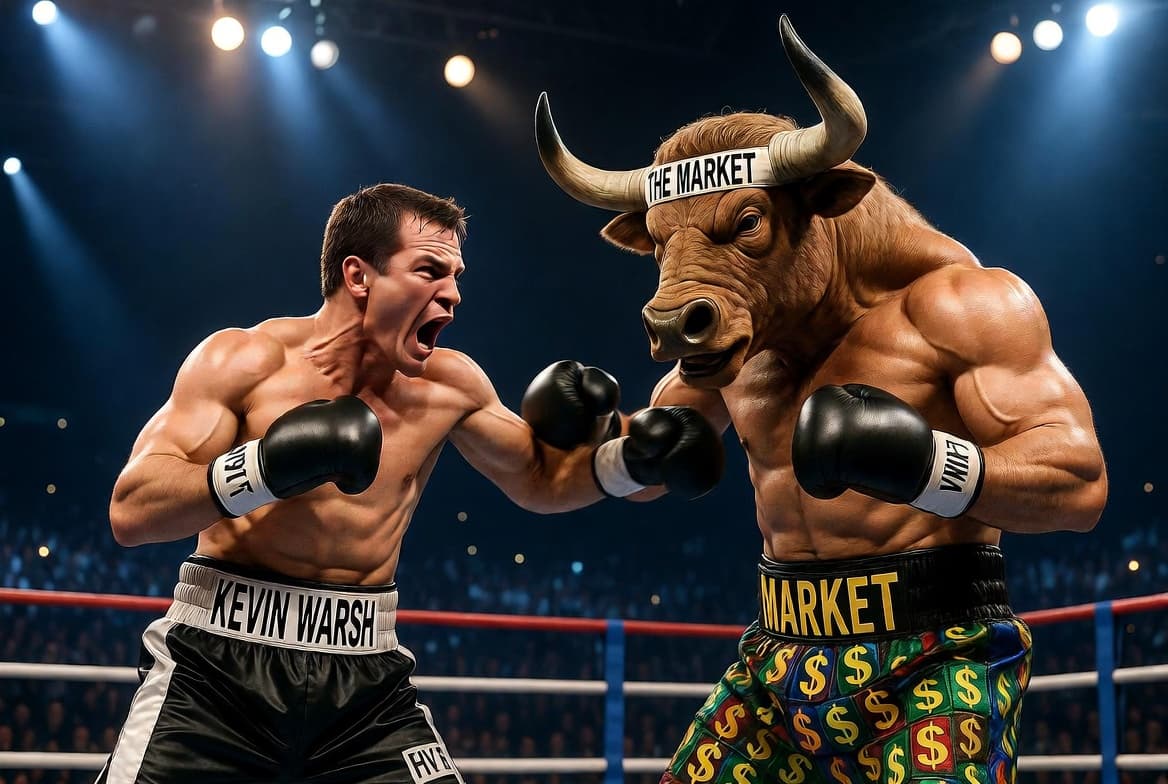
Round Four — the KO, if the market throws in the towel
Nobody knows yet if there's a fourth round where the towel comes in. That's not a prediction — it's the honest state of the data heading into tomorrow. What's certain is this: a Fed chair who dropped forward guidance on purpose has turned every single print into a live round, and tomorrow's is the biggest one since he picked up the gloves.
THE NUMBERS BEHIND THE BOUT
Every 2026 NFP release vs. same-day S&P reaction — plus the scenario map for Round Three.
The full track record: every 2026 NFP release plotted against the actual same-day S&P 500 (SPX) reaction, pulled directly from OHLC price data — plus the complete scenario map for tomorrow's Round Three.
SPY · Regime Intelligence engine (Asset Sheet cards)
SPY · SPDR S&P 500 ETF Trust
$768.56 ▼ −1.18 (−0.2%)
Snapshot · Aug 6, 2026 · 18:11 ET
Same five-state regime labels and Market Structure reads as the RI Asset Sheet — pulled from the live engine at snapshot time.
Regime — all timeframes
Market structure
The Complete 2026 Track Record: NFP Surprise vs. S&P 500 Reaction
| Month | Release Date | Actual | Consensus | Surprise | S&P Open | S&P Close | Day Chg |
|---|---|---|---|---|---|---|---|
| Jan 2026 | Feb 11 | +130K | +70K | +60K | 6,976.48 | 6,941.47 | −0.50% |
| Feb 2026 | Mar 6 | −92K | +50K | −142K | 6,769.03 | 6,740.02 | −0.43% |
| Mar 2026 | Apr 3* | +178K | +60K | +118K | — | — | closed |
| Apr 2026 | May 8 | +115K | +55K | +60K | 7,362.97 | 7,398.93 | +0.49% |
| May 2026 | Jun 5 | +172K | +85K | +87K | 7,537.36 | 7,383.74 | −2.04% |
| Jun 2026 | Jul 2 | +57K | +115K | −58K | 7,495.14 | 7,483.24 | −0.16% |
| Jul 2026 | Aug 7 | ? | ~80–120K | ? | — | — | pending |
* March's release fell on Good Friday — U.S. equity markets were closed. The first tradeable reaction came the following Monday (Apr 6), when the S&P closed +0.44% from the prior close, a muted response for a +118K beat given the market had a full weekend plus a holiday to digest it before trading it.
After back-to-back strong readings in March and April, the market had the wind at its back — riding a nearly 1,000-point run on the S&P from April 7 through June 2 (6,617 to 7,610, roughly +15%), shrugging off Warsh's swearing-in on May 22 along the way. The reprieve ended fast: the May jobs report on June 5 hit the index for its worst single day of the year, and by June 9 the S&P had fallen to an intraday low near 7,240 — a 5% drawdown in under a week. You'd assume that was the wake-up call. It wasn't. The index whipsawed through June and July — including another sharp leg down after the contested July 29 vote — only to grind out a fresh all-time high on August 5.
Reading Between the Lines
In four of the six tradeable sessions this year, NFP beat consensus — sometimes by a wide margin — and the S&P still closed lower on the day.
- Jan 2026: beat by 60K → S&P −0.50%
- Apr 2026: beat by 60K → S&P +0.49% (the only clean “beat = up day” in the sample)
- May 2026: beat by 87K → S&P −2.04% (the single worst day in the entire table)
- Jun 2026: missed by 58K → S&P −0.16% (a miss that barely moved the index)
The May 2026 print is the clearest illustration of why headline-chasing is a poor framework for trading NFP: the print itself beat consensus comfortably, but the same release also carried a combined 74,000-job downward revision to the prior two months once finalized — and it was that revision story, not the May headline, that the market was actually pricing on the day.
Implication
A regime-aware read of NFP days should weight revisions to the prior two months and the unemployment/participation combination at least as heavily as the headline surprise — the headline alone has had limited same-day explanatory power for S&P direction in 2026.
The FOMC Backdrop, in Full
- The vote (Jul 29):3.50%–3.75% hold, but by a 9–3 margin — the largest dissent count of Warsh's tenure, with three regional presidents pushing for an immediate hike.
- The tone: Warsh explicitly rejected any “soft implicit target” on inflation and framed the hold as “the beginning of the story, not the end.”
- The mechanism shift: Warsh has deliberately reduced Fed forward guidance, telling markets to trade the data directly — precisely why NFP, ADP, and CPI prints are moving markets harder than they have in years.
What's happened to pricing since: in the week before the July 29 meeting, September hike odds spiked to roughly 82% on oil-driven inflation fear tied to the Iran conflict. Since then, progress toward a Strait of Hormuz reopening deal has knocked oil down sharply, and soft labor data (June's NFP miss, this week's weak ADP) has reintroduced the “labor market cooling” counter-argument. The result: the dollar has drifted to a seven-week low, gold has rallied to a seven-week high, and the 10-year yield has eased from its post-FOMC spike — even though the headline Fed stance from July 29 was unambiguously hawkish.
Where Things Stand Heading Into Tomorrow
Consensus: ~80–120K net jobs added (median closer to 85K), unemployment ticking up to 4.2–4.3% from June's 4.2%, average hourly earnings +0.3% m/m (3.5% y/y).
- ADP private payrolls (Wed): just +44K in July — well below both June's +95K and the +75K consensus.
- Initial jobless claims (Thu): ticked up slightly to 199K for the week of Aug 1 — still historically low.
- Challenger job cuts (Thu): July layoffs fell to their lowest level in two years — a genuinely positive counter-signal.
- Continuum Economics expects a moderate beat (120K), driven by a leisure/hospitality snapback after June's anomalous −61K.
Net: the inputs are genuinely mixed, which is exactly why this print carries more weight than usual.
Scenario Analysis: How Each Asset Class Is Likely to React
Scenario A — Strong Print (>130K, unemployment steady/down, wages firm)
- Equities: Usually negative, especially richly-valued AI/tech
- Gold: sharp pullback from the current seven-week high
- DXY: sharp bounce off the seven-week low; likely reclaims 100+
- Crypto (BTC): Often downside pressure correlated with the tech/risk-asset reaction, though less reliable than the others.
- Yields: 10-year and 2-year both push higher
Scenario B — In-Line Print (80–120K, unemployment 4.2–4.3%, wages ~3.5%)
- Equities: modest relief if unemployment doesn't spike, but likely muted and choppy
- Gold: likely holds recent gains or consolidates
- DXY: likely range-bound near current lows
- Crypto: low-conviction chop
- Yields: limited net move; watch the wage component specifically
Scenario C — Weak Print (<60K, or sharp downward revisions, unemployment >4.3%)
- Equities: initially positive on rate-cut hope, but could flip quickly if read as a growth scare
- Gold: strong tailwind toward $4,300–4,334 resistance analysts have flagged
- DXY: fresh lows likely
- Crypto: likely benefits alongside gold on rate-cut repricing
- Yields: sharp downside move at the short end as September hike odds collapse
What to Actually Watch Beyond the Headline
- Revisions to May and June — this cycle's defining feature has been strong headlines quietly erased a month later.
- Unemployment rate and labor force participation together — June's drop to 4.2% was flattered by a shrinking labor force.
- Wage growth — with Warsh unwilling to tolerate a “soft” implicit ceiling, a hot wages number could hawkishly reprice markets even alongside soft payrolls.
- Sector composition — specifically whether leisure/hospitality rebounds as expected after June's anomalous −61K.
- Average hourly earnings × average weekly hours — arguably the most underrated line in the whole release.
Why hours × wages matters more than the headline
The payroll count alone says nothing about income. Average Hourly Earnings combined with the Average Workweek approximates aggregate labor income growth — the actual fuel for consumer spending, which is roughly two-thirds of GDP. A headline beat with flat-to-falling hours and soft wage growth can still mean weakening income and disinflationary pressure underneath; a headline miss with firm hours and firm wages can mean the opposite.
Bottom line
The 2026 track record shows a market that has stopped trading the NFP headline in any simple, mechanical way — four of six releases this year produced a same-day S&P move in the opposite direction implied by naive beat/miss logic. Combined with a Fed that has deliberately stopped offering forward guidance and is now trading purely off incoming data, tomorrow's print carries outsized weight less because of what the headline number will say, and more because of how the revisions, wage data, and unemployment internals reshape the market's read on September. Round Three is live in less than a day — and unlike the last two, this one won't wait for a press conference to land.
Sources
S&P 500 (SPX) OHLC data: Interactive Brokers. Economic and market commentary: U.S. Bureau of Labor Statistics, CNBC, Bloomberg, Reuters, Zillow Research, Indeed Hiring Lab, EmployAmerica, Yahoo Finance, TheStreet, Trading Economics, Kiplinger, Continuum Economics, ADP Research, CME FedWatch, Polymarket, Forbes, FX Leaders, LiteFinance, FactSet, ForexFactory, Chase, NBC News.
Disclosure: Compiled for internal research use. Not investment advice.